An online vote is a fundamental moment of democracy and governance. Beyond the decisions it produces, it is also a time for exchange, where dialogue, debate and freedom of expression must be safeguarded. The Voteer platform supports every organization to ensure a secure, transparent and compliant online voting process.
👉 Understand why voting is highly important
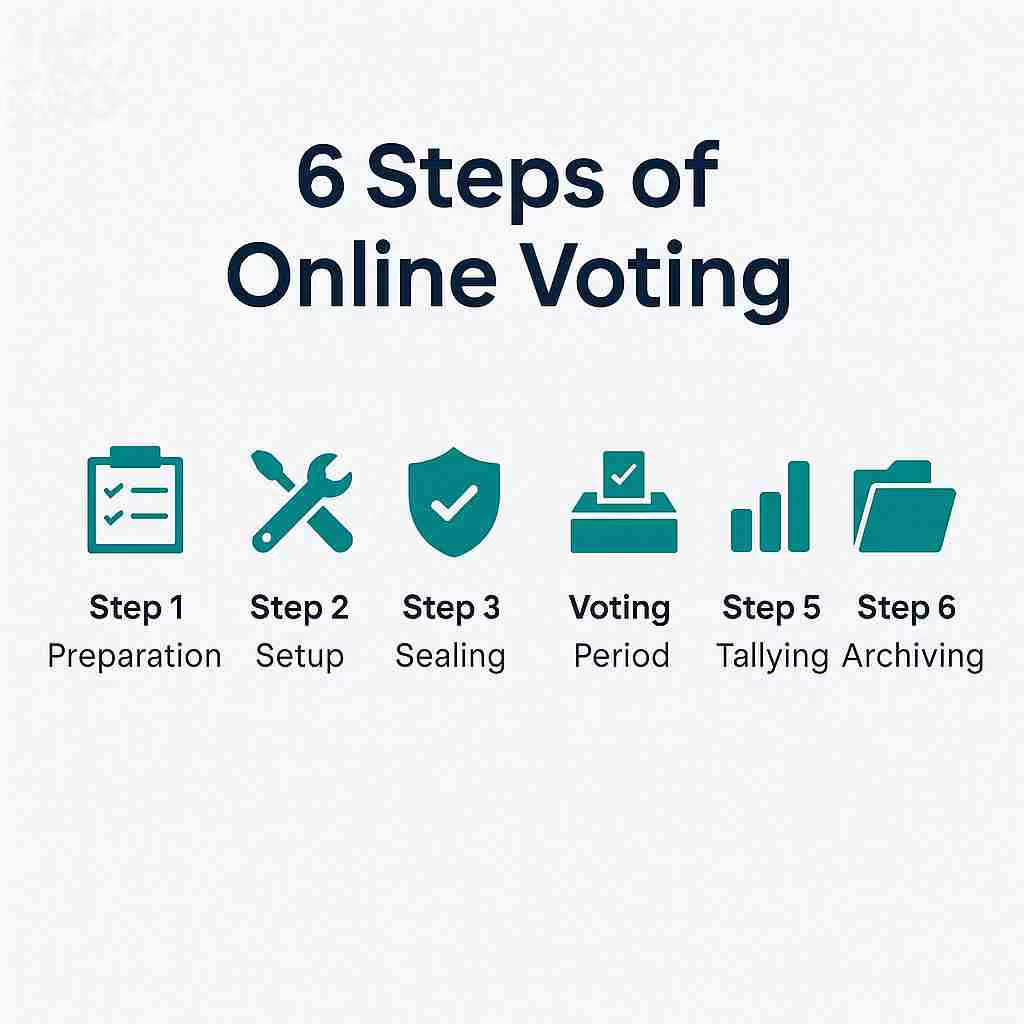
Step 1 – Ballot preparation
An online voting process is not limited to the voting period itself. Its success relies on rigorous preparation, which includes:
✨ defining the ballot rules and voting modalities: secret or open ballot, quorum, weighted votes, proxies, voting over a period or live, on-site, videoconference or hybrid ;
✨ selecting the types of votes: single choice, multiple choice, list voting with or without strikeouts ;
✨ accounting for abstention, whether recorded as non-expressed or factored into the results ;
✨ drafting a detailed schedule covering all milestones (communication, sealing, opening and closing of the vote, counting) ;
✨ establishing and validating the voter list ;
✨ launching the call for candidates and validating candidacies (for elections) ;
✨ drafting the votes (resolutions, elections, consultations).
Even if these rules are framed by bylaws, statutes or law, they are consolidated into a single document that can be shared with all stakeholders and, if needed, negotiated and signed to ensure clarity and consensus.
Step 2 – Setup
🖋️ Ballot setup: name, schedule, ballot type, activation of features (group, registrations, proxies, attendance management, Q&A, publications).
⚙️ Operational preparation: import and verification of the voter list, scheduling of email/SMS communications, import of publications, creation of ballot questions.
▶️ Test ballots: organization of one or more test ballots under real conditions to verify the system’s proper functioning and train stakeholders.
Step 3 – Sealing
The sealing ceremony brings together organizers, the election board, supervisory commissions and observers. Its purpose is to lock the ballot and guarantee its integrity.
✅ Verification of ballot settings ;
✅ Validation of the voter list ;
✅ Validation of the communication campaign ;
✅ Validation of ballots and voting modalities ;
✅ Generation of decryption keys for ballot boxes (stored in a secure server (Decryption Key Vault),or distributed (Decryption Key Distribution) among ballot committee) ;
✅ Final sealing of the ballot.
On the platform, sealing is reflected by the ballot status moving from “Draft” to “On going”. A sealing code is generated, serving as auditable proof of system integrity.
Step 4 – Voting period
Each voter receives secure credentials by email and/or SMS and connects through a web browser.
During this period, voters can:
🗝️ authenticate securely ;
📄 consult publications and candidate statements (if enabled) ;
❓ submit questions via the Q&A module (if enabled) ;
👥 confirm or validate their attendance at the meeting (if enabled) ;
📝 check in at the meeting, whether on-site, online or hybrid (if enabled) ;
🤝 assign a proxy (if enabled) ;
🗳️ vote and receive proof of ballot deposit.
Meanwhile, organizers supervise the ballot in real time, monitoring participation rates and attendance. A dedicated support team is available at all times to assist both voters and organizers.
Step 5 – Counting
At the closing of the ballot, votes are counted securely. Counting only takes place once the ballot is definitively closed, ensuring there is no partial tally during voting.
Results are immediately displayed in the organizer’s interface and, if enabled, in the voter’s application. Official, secure reports are generated automatically.
Step 6 – Closing, archiving and data deletion
The ballot is closed by the organizer. Voters then no longer have access to the voting interface.
Essential data and reports — results, minutes, attendance lists — are archived securely to enable audits and comply with regulatory obligations.
At the end of the defined retention period, all data, including personal information and ballots, are permanently deleted.
👉 Learn how to write a general meeting minutes
Why choose online voting?
Online voting has become a modern, secure and accessible solution. It simplifies ballot organization, reduces logistical costs, and ensures participation regardless of voter location. Above all, it offers a high level of transparency thanks to sealing, encryption and process traceability. By fostering accessibility and inclusion, it strengthens the legitimacy of collective decisions.
👉 Discover why online voting is your best choice for your next ballot