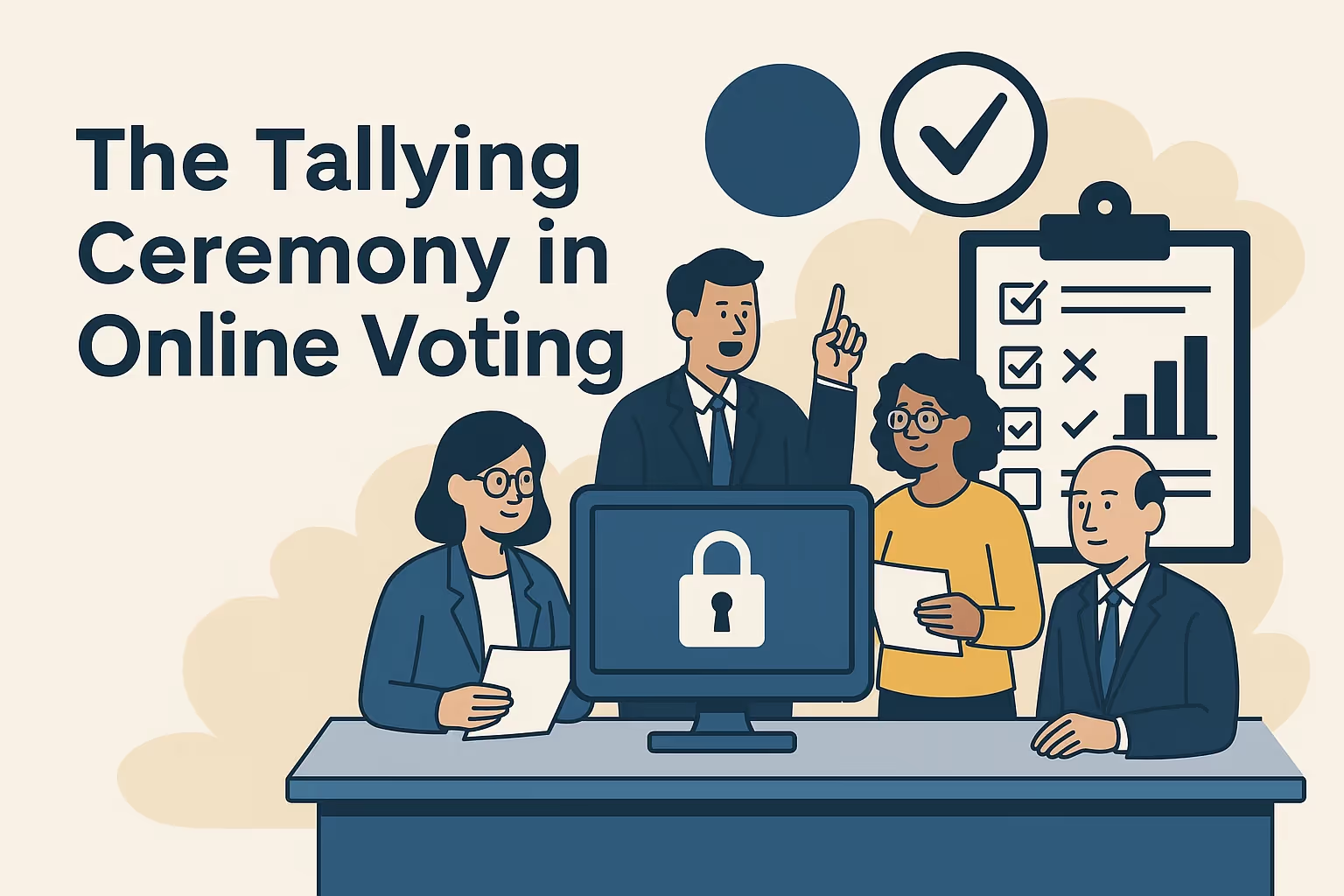
What Is the Tallying Ceremony in an Online Voting System?
The tallying ceremony is the closing counterpart to the sealing ceremony.
If the sealing ceremony marks the official start of a ballot, the tallying ceremony confirms its conclusion — ensuring that the entire process remains transparent, verifiable, and auditable from beginning to end.
Just like the sealing session, this procedure is public, collective, and supervised.
It gathers the same key participants:
- the Online Voting Committee (or Supervisory Committee),
- the technical oversight team,
- and sometimes external observers or representatives.
The ceremony begins immediately after the online vote closes.
Its goal: to decrypt the virtual ballot boxes, calculate the results, and formally certify the outcome in a transparent and secure environment.
🔗 To learn more about the first part of this process, read our article on the Sealing Ceremony in Online Voting.
The Key Steps of the Tallying Process
The tallying ceremony follows a clearly defined sequence of operations to ensure both the integrity of the system and the accuracy of the results.
1. Integrity check
Before any decryption begins, the Online Voting Committee verifies that the sealing code remains unchanged.
This step confirms that no technical modification occurred after the sealing ceremony.
If the code matches the original hash, the system’s integrity is confirmed — the digital equivalent of confirming that a physical ballot box seal remains intact.
2. Decryption key activation
The decryption keys are activated to allow the decryption of all encrypted ballots and the secure opening of the virtual ballot box.
Depending on the configuration:
- the keys may have been distributed among several members (Decryption Key Distribution), or
- securely stored in a Decryption Key Vault on a sealed server.
When the keys are stored in a vault (also known as a secret server), the decryption step is automatic and traceable, triggered only under the committee’s supervision.
In other configurations, the committee members manually enter their keys, and only when the required number of keys is provided can the decryption proceed.
This collective mechanism ensures that no individual can access the ballots alone and that every action is securely logged and auditable.
3. Tallying (vote counting)
Once the urns are opened, the platform automatically decrypts each encrypted ballot and counts the votes according to the voting rules defined during the setup.
The Online Voting Committee then reviews the raw counting results, including the number of responses per proposal, per list, and per candidate.
All operations are logged, timestamped, and secured, guaranteeing a fully auditable tally.
4. Results announcement
After counting, the Online Voting Committee proceeds to interpret and proclaim the results:
- Has the quorum been reached?
- Are resolutions adopted (e.g., more than 50% “For” votes)?
- Who is elected, based on the type of vote:
At this stage, the committee validates the results and records them in the official report.
5. Edition of official documents
Once results are verified, the platform generates all the certified reports, including:
- the attendance sheet, showing who voted;
- the certified results minutes.
These documents provide a complete and verifiable trace of the process.
6. Online publication of results
After validation, the results are published directly on the voting platform — or through any other means decided by the Online Voting Committee
Each voter can access the final report, ensuring complete transparency and traceability of the process.
Validation, Transparency & Contestation Period
At the end of the tallying ceremony, the Online Voting Committee validates the minutes, attendance record, and official results.
They are then communicated to all voters and stakeholders.
A contestation period follows the official proclamation.
During this time:
- all encrypted ballots, decryption logs, and system traces are securely stored;
- results can be recomputed or audited under judicial supervision, if required;
- and no data can be altered.
Once the legal or statutory contestation period has expired, all personal and voting data are permanently deleted from the platform — completing the ballot lifecycle.
This approach balances transparency, data protection, and legal compliance, ensuring that every vote remains both confidential and verifiable.
Why the Tallying Ceremony Ensures Digital Trust
The tallying ceremony is not just an administrative task — it’s a cornerstone of digital democracy.
It mirrors the transparency of the sealing ceremony, but at the opposite end of the process.
Together, the two ceremonies form a closed, verifiable chain:
- the sealing ensures that nothing can be modified before or during the vote;
- the tallying ensures that results are decrypted, calculated, and published according to the rules.
This symmetry builds trust among all participants:
- Voters know that their voice was counted exactly as cast.
- Organizers have verifiable proof that the election was conducted in a secure, auditable environment.
- Observers can confirm the legitimacy and fairness of the entire process.