What Is the Sealing Ceremony in an Online Voting System?
Before online voting existed, a sealing ceremony was already a cornerstone of transparency in paper-based elections.
The Voting Committee — or the supervisory committee for operations — would check the voter list, the ballots, and the candidate lists or resolutions, then publicly confirm that the voting materials were ready and that the ballot box was empty and properly locked before voting began.
The goal was simple: ensure transparency and trust by showing that everything was in order before voters started casting ballots.
In an online voting system, this tradition continues in digital form.
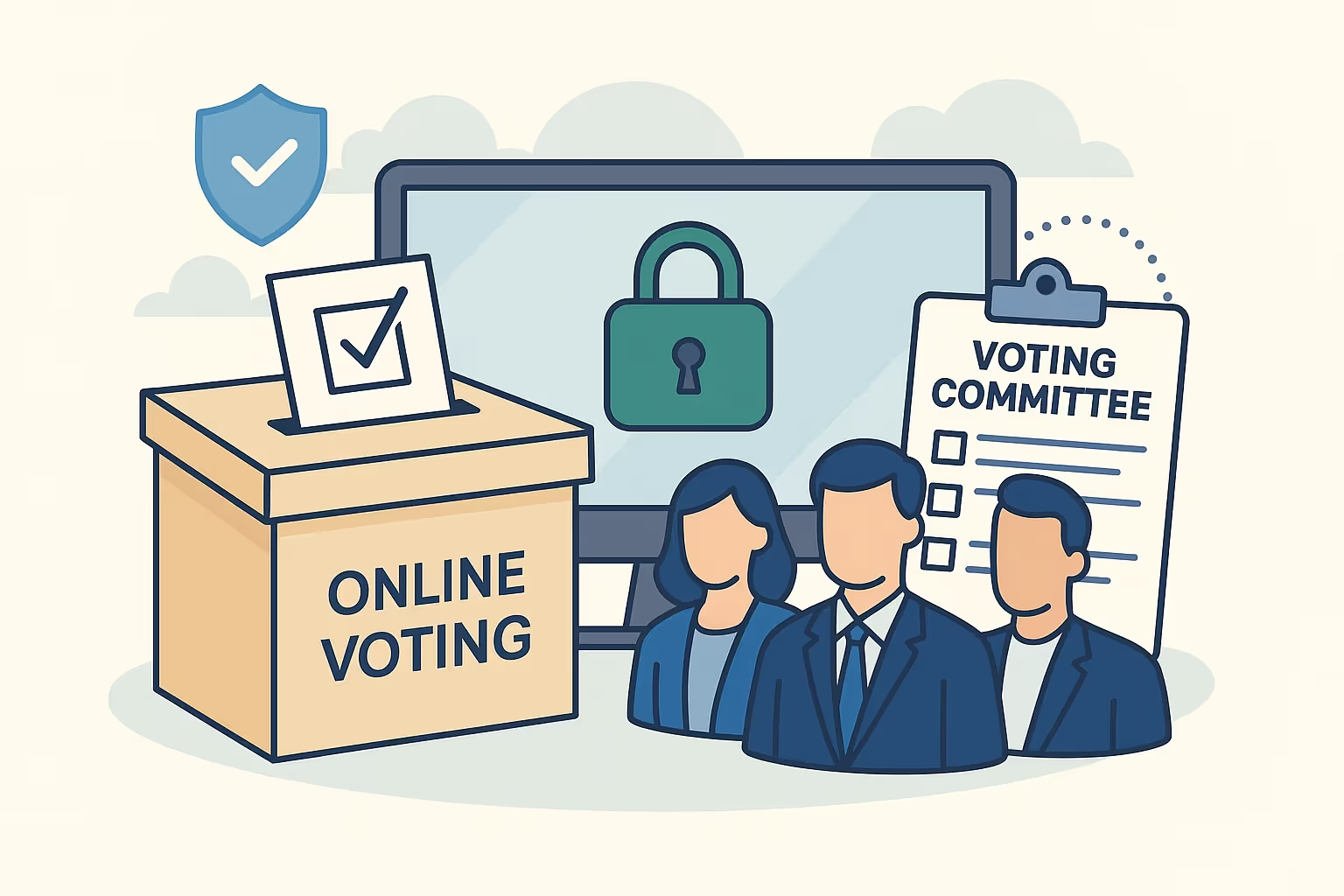
The sealing ceremony, public and open to all stakeholders, takes place under the responsibility of the Voting Committee (or the Supervisory Committee).
It brings together organizers, the Online Voting Committee, the technical support team, and sometimes external observers.
Its purpose is to freeze the election configuration and guarantee integrity before the voting period opens.
This step — documented and available to authorized representatives — marks the official start of the vote.
It allows everyone to verify that the system is ready, that parameters have been validated, and that the digital ballot box is secured.
It is the starting point for transparency and shared confidence in any online vote — whether a work council election , a general meeting, a referendum, a board election, or any other ballot.
🔗 To explore all the steps involved in an online voting process, visit: How Online Voting Works: Key Steps with Voteer
What Role Does Sealing Play in Transparency and Security?
Digital sealing is far more than a technical step: it is a collective commitment to transparency and integrity.
It ensures that the online voting system matches its validated configuration and that no change can occur without detection.
In other words, sealing turns abstract trust into tangible, auditable proof of integrity and reliability.
Ensuring the Integrity of the Vote
Sealing guarantees that all ballot rules and parameters — voting period, voter list, resolutions / candidate lists, scheduled messages, and published documents — are validated before opening.
Once sealed, the system becomes locked and auditable: any subsequent change is automatically flagged.
Cryptographic fingerprints and the sealing code allow anyone to verify, at any time, that the system state remains identical to the one recorded at sealing.
This is essential to the regularity and sincerity of the vote.
Preventing Any Post-Sealing Modification
Sealing acts as a digital barrier: no parameter and no ballot box can be altered during the voting period.
This full traceability strengthens process security and allows auditors to demonstrate system stability throughout the election.
In practice, if an exceptional change is required (e.g., adding or correcting a voter), it must be authorized, justified, and fully logged, preserving transparency and accountability.
Establishing Verifiable Confidence
Sealing is not merely symbolic: it is a technical, auditable guarantee that materializes trust in the system.
It reassures voters that their vote is cast in a secure, controlled, and impartial environment.
It gives organizers and committees certainty that the ballot has opened under conditions that are fully mastered and traceable.
This step underpins the credibility of the entire process: every action is recorded, every piece of data protected, and everyone can obtain proof that the vote takes place in an honest, compliant environment.
When and How Does the Sealing Ceremony Take Place?
The sealing ceremony occurs immediately before opening, once all voting parameters have been validated.
It formalizes the transition to the final state of the election: the system is ready to receive secure ballots.
Traditionally held in person, it is now most often conducted via video conference, making it easier for all stakeholders to participate — especially when members of the Online Voting Committee, observers, or voter representatives are on different sites.
Video also allows the session to be recorded to preserve evidence and traceability.
The ceremony is supervised by the Online Voting Committee , which ensures proper operations.
For large or multi-site ballot, it may also involve a Central Online Voting Committee coordinating several committees or supervising the consolidation of records.
Whatever the setup, the session remains public, collegial, and controlled, ensuring the system is verified, validated, and ready to open in a fully transparent environment.
Checks Performed During the Sealing Session
During sealing, the team in charge performs a series of checks to ensure the system is complete, compliant, and ready to open.
These controls are carried out in the presence of the voting committee to ensure collective validation.
Key steps include:
- ✅ Election parameters: opening/closing times, voter authentication rules, quorum, proxy options where applicable, and the voting mode (over a period or live; in-person, remote, or hybrid).
- ✅ Voter list verification: alignment with the validated version, no duplicates or omissions, correct display in the platform.
- ✅ Published materials: candidate statements, budget, financials statements, or informational documents — complete, accurate, and accessible on the platform.
- ✅ Communication plan: scheduled email and SMS messages, including automatic reminders and targeted follow-ups to non-voters, ensuring timing, neutrality, and fairness.
- ✅ Resolutions / candidate lists : content shown to voters matches the version validated by decision-making bodies — no errors or changes.
- ✅ Digital ballot boxes: boxes confirmed empty, sealed, and correctly identified before the vote starts.
- ✅ System tests: vote simulation, verification of encryption and correct operation of the interfaces before sealing.
- ✅ Access control & committee training: each committee member has personal credentials and functional access to the supervision dashboard (“backstage”), plus a recap of best practices and core features.
- ✅ Decryption key generation : creation of decryption keys, either distributed among committee members or stored in a secure digital vault.
- ✅ Final sealing: generation of an auditable sealing code, confirming the system is locked and ready to accept ballots.
Every action is timestamped and automatically logged in the sealing report, available for review by the Online Voting Committee or the Supervisory Board
Decryption Keys and Sealing Security
One of the essential steps of the sealing ceremony is generating the decryption keys for the digital ballot boxes.
These keys are the only way to “open” the ballot box at the end of the voting period, during the tallying ceremony.
They are central to the security model: as long as they are not brought together, no access to vote content is possible.
Two Possible Key-Management Modes
Depending on the organization, the platform offers two distinct modes:
🔐 Decryption Key Distribution
Keys are distributed among several members of the Online Voting Committee.
Each person holds a share of the overall key, and combining a minimum threshold is required to decrypt the ballot boxes.
As a rule of thumb, three keys are generated and any two are sufficient to authorize decryption and start counting.
There is no fallback mechanism: if keys are lost or inaccessible, ballots cannot be decrypted and no tally can be performed.
This ensures absolute confidentiality but requires strict custody and transfer procedures.
To reduce risk and operational stress, keys may instead be stored in a secure server — a true digital key vault — preserving integrity while simplifying management for the committee.
🗄️ Decryption Key Vault
Keys are stored in a secure, encrypted server (“secret server”).
Access is tightly controlled, and every action is timestamped and logged.
This mode guarantees no risk of key loss while maintaining maximum security.
It is often preferred when the Online Voting Committee does not wish to manage keys manually, and for general meetings or board sessions where live tallying must occur as debates progress.
A Guarantee of Collegiality and Integrity
Whichever mode is chosen, one fundamental principle applies:
no single actor holds the power to access the digital ballot boxes.
This collegial model is the keystone of trust in the voting process, ensuring that tallying can only occur in the presence and with the consent of the committee, under transparent, controlled conditions.
All operations related to keys — generation, distribution, storage, and verification — are recorded in the sealing log.
This provides complete traceability and stands as the first proof of integrity even before the vote opens.
🔗 For the next step (reuniting keys, decryption, counting), see: The tallying ceremony: decrypting and counting securely
Digital Fingerprints and the Sealing Code
At sealing time, the system computes a unique digital fingerprint (hash) representing the complete state of the election: configuration, voter list, publications, messages, keys, and ballot boxes.
This fingerprint serves as the election’s technical signature and ensures the system has not been altered since the ceremony.
An Auditable Sealing Code
Once the fingerprint is computed, the platform generates a sealing code.
This code is proof of integrity: it can be checked at any time, automatically or on demand.
Each recalculation compares the current system state with the original fingerprint.
The verification history is fully downloadable and includes:
- the initial fingerprint and all recalculated hashes;
- the date and time of each verification;
- the identity of the person or service that initiated the check.
In Voteer’s supervision back office, a visual indicator makes it easy to read
- 🟢 Sealing code unchanged: integrity confirmed.
- 🔴 Sealing code modified: alert — the system has changed since the last check.
Compliance and Legal Frameworks
Wherever online voting is regulated or subject to compliance obligations, sealing — and especially ballot-box encryption — is non-negotiable.
The sealing code is its technical expression, materializing the integrity guarantee expected by regulations — whether for an election, a general meeting, or a any ballot under the supervision of an authority.
It proves, in a verifiable and documented way, that the system remained unchanged and secure throughout the voting period.
Sealing is therefore not just a best practice: it is a compliance requirement in any regulated online voting context.
Sealing on the Voteer Platform
On Voteer, the sealing ceremony can be organized via video conference, enabling participation from the Online Voting Committee, observers, and representatives, wherever they are.
The entire session can be recorded to preserve evidence and traceability.
Once the ceremony is completed:
- the election moves from “Draft” to “Ongoing”,
- a unique sealing code is generated, and
- all actions are automatically logged in the audit journal.
This journal includes:
- timestamps for every operation;
- identities of participants;
- technical information about ballot boxes, keys, and fingerprints;
- and a voter connection log (date, time, IP address, device).
All of this data can be exported or archived for later verification, ensuring the election is fully traceable while preserving ballot secrecy.
With this approach, Voteer turns sealing into a smooth, transparent, and auditable procedure — without technical complexity for participants.
Why Sealing Is Essential to Collective Trust
Sealing is not a formality: it is the foundation of digital trust in any online voting.
It combines a technical guarantee with auditable proof of the process’s honesty.
Once the election is sealed, voters, organizers, and observers alike can be confident that it opens in a controlled, secure environment.
Sealing reassures voters that their voice will be recorded in a safe, impartial, and transparent framework.
It gives organizers the certainty that the election is under control, in a frozen, validated, and traceable environment.
It is a technical, legal, and symbolic guarantee that underpins the legitimacy of online voting.
By reflecting the spirit of participatory governance — collegiality, transparency, and accountability — sealing provides tangible proof of integrity for every type of vote: work council elections, general meetings, referendums, or board elections.
With Voteer, this requirement becomes a simple, seamless, and well-governed experience.