The digital ballot box has become a key component in modernizing voting for companies, associations, nonprofits, public agencies, unions, and professional organizations.
With the rise of online voting, expectations around transparency, security, accessibility, and speed are higher than ever. The digital ballot box — the technical core of the voting system — plays a crucial role in protecting ballot integrity.
How does a digital ballot box work? How does it differ from a traditional paper ballot box? How is it secured? And what regulations apply in the US, UK, and internationally?
This guide provides a clear and comprehensive explanation of every critical aspect.
What Is a Digital Ballot Box?
Definition and How It Works
A digital ballot box is a secure, encrypted system used to collect and store online ballots, in the same way a traditional ballot box stores paper ballots.
It ensures tamper-proof, encrypted, and fully independent storage, completely isolated from the voter list or the attendance record.
Its purpose is simple: replace the paper ballot box while providing stronger transparency and security through cryptographic protocols and auditable procedures.
Components of a Digital Ballot Box (software, interface, database)
A digital ballot box relies on three major components:
1. The Voting Interface
The voting interface allows voters to cast their ballot in any type of election:
- resolutions,
- single-member elections,
- multi-member elections,
- list-based elections,
- weighted votes or multi-constituency votes.
It must be accessible from any device — laptop, smartphone, tablet — and offer a clear, intuitive, inclusive design.
It enables voters to participate without having to travel, significantly increasing participation rates.
2. The Voting Engine
The voting engine ensures that the ballot is correctly expressed, processed and protected, based on the security principles:
- cast-as-intended,
- recorded-as-cast,
- counted-as-cast.
It manages:
- ballot validation,
- encryption,
- insertion into the digital ballot box,
- sealing mechanisms.
3. The Secure Database — the Digital Ballot Box Itself
The ballot box database is fully encrypted, and each ballot is encrypted end-to-end, from the voter’s device to final storage.
It is completely separated from the voter list, and stores no timestamps, preventing any correlation between a ballot and the moment a voter checked in.
Before tallying, the ballot box undergoes a cryptographic shuffle, breaking the order of arrival to mathematically guarantee ballot anonymity.
How an Online Vote Is Conducted Using a Digital Ballot Box
Identification & Voter Access
Voters access the voting platform through:
- a secure link,
- a unique identifier,
- or multi-factor authentication (up to 3 factors) when required.
Casting the Ballot
Voters review candidates, resolutions or options and cast their ballot through an intuitive and user-friendly interface.
Encryption & Ballot Storage
The ballot is encrypted and digitally signed directly on the voter’s device before leaving it.
Transport to the servers is fully encrypted, preventing interception or manipulation.
This makes it technically impossible to:
- alter a ballot in transit,
- inject fraudulent votes,
- carry out ballot stuffing.
Once received, the ballot is stored in the encrypted ballot box, without timestamps, and shuffled.
Digital Ballot Box vs Paper Ballots: Key Differences
Accessibility & Ease of Use
With a digital ballot box, voters can participate from any device, anywhere, without traveling.
The interface is designed to meet strict accessibility standards WCAG 2.2 (Web Content Accessibility Guidelines) to support all voters, including those with disabilities.
Instant Tallying & Result Processing
When the vote closes, the ballot box is opened and tallied immediately.
Results include:
- the voter list (with timestamps),
- participation rates,
- detailed results,
- proxy reports,
- connection logs,
- technical audit logs.
Risks & New Security Guarantees
A digital system eliminates risks linked to paper: lost ballots, manual counting errors, misinterpretation, or slow tallies.
It provides:
- strong encryption,
- auditable sealing,
- distributed decryption keys,
- strict access control,
- mathematical guarantees of integrity.
Security & Confidentiality: How the Digital Ballot Box Protects the Vote
End-to-End Encryption of Ballots
Every ballot is encrypted end-to-end.
Even system administrators cannot access or read the content.
The ballot box can only be opened using decryption keys held by the election board members, the election committee, or stored in a secure key vault server designed to protect decryption keys.
Sealing & Traceability
Sealing prevents any modification of the ballot box after the vote begins.
An auditable seal code is provided to monitoring authorities.
Traceability relies on technical logs that can be audited by neutral third parties.
Anonymity & Protection of the Secret Ballot
Anonymity is guaranteed through:
- full separation between the ballot box and voter list,
- absence of timestamps inside the ballot box,
- cryptographic shuffling,
- adherence to international security guidelines.
📌 Good to Know — ballot box Shuffle - A shuffle is essential for privacy: it ensures that no link can be made between the check-in time and the position of a ballot in the box. It is a standard used internationally to enforce secret ballots in online voting.
Use Cases: Businesses, Associations & Public Institutions
Online Voting for Businesses (board elections, referendum, shareholder meetings)
Digital ballot boxes are widely used for:
- board elections,
- employee representative elections,
- referendum,
- company-wide agreements,
- shareholder meetings and associate general meetings. AGM
They simplify organization, guarantee legal compliance, and significantly increase participation.
Online Voting for Associations & Nonprofits
Associations use digital ballot boxes for:
- approving resolutions,
- budget votes,
- elections of board members,
- general assemblies.
Online Voting for Public Sector & Government Bodies
Public institutions use digital ballot boxes to run:
- elections for internal committees and boards,
- administrative councils,
- commissions and working groups,
- citizen consultations,
- participatory votes,
- internal governance procedures.
They meet strict transparency, accessibility and security requirements expected from public-sector processes.
Legal & Regulatory Framework for Online Voting
International Standards (US, UK, Europe & Global)
Online voting is governed by different regulations depending on the country or sector.
Below is a clear overview of the main standards and guidelines in the United States, the United Kingdom, Europe, and international bodies.
🇺🇸 United States
In the US, online voting is not federally standardized for public elections, but is widely used in corporate governance, associations, unions, cooperatives, HOAs, and professional bodies.
Key standards include:
- HAVA (Help America Vote Act) – establishes accessibility and reliability requirements.
- EAC VVSG (Voluntary Voting System Guidelines) – technical standards for secure voting systems.
- NIST Cybersecurity Framework – guidelines for encryption, authentication, and system hardening.
- State-level corporate governance laws, such as:
- Delaware General Corporation Law (DGCL)
- Model Nonprofit Corporation Act (MNCA)
These standards emphasize:
✅ strong authentication
✅ encryption and data protection
✅ auditability
✅ accessibility
✅ integrity of vote storage and counting
🇬🇧 United Kingdom
In the UK, online voting is permitted and widely used in:
- membership organizations,
- charities,
- trade associations,
- cooperatives,
- professional bodies,
- corporate governance processes such as AGMs.
Key frameworks include:
✅ Electoral Commission Guidance – for secure remote participation.
✅ Representation of the People Act – overarching legal principles.
✅ Companies Act 2006 – governing shareholder votes and electronic participation.
✅ Charity Commission guidelines – for voting in charities and associations.
UK regulation emphasizes transparency, accessibility and the ability to verify results.
🇪🇺 Europe (EU Standards & Council of Europe Guidelines)
In Europe, online voting is strongly influenced by pan-European standards and recommendations, especially for associations, federations, cooperatives, public institutions and cross-border organizations.
Key references include Council of Europe Recommendation CM/Rec(2017)5
The most important European text on e-voting, defining:
✅ end-to-end encryption
✅ separation of identity and ballots
✅ mandatory anonymization
✅ auditability
✅ transparency
✅ verifiable processes
✅ GDPR (General Data Protection Regulation)
🌍 Global / International Standards
Despite differences in national regulations, most countries and institutions rely on the same core principles of secure online voting. These principles — end-to-end encryption, ballot secrecy, auditability, system integrity and voter verification — are not arbitrary. They come from decades of academic research, cryptographic innovation, and real-world experimentation carried out by universities, election experts, and international scientific bodies.
Whether in the United States, the United Kingdom, Europe or anywhere else in the world, modern online voting systems are built on this shared foundation of knowledge.
A digital ballot box is therefore not just a technical tool, but the result of rigorous peer-reviewed research, continuously improved by the scientific community to ensure that online voting remains secure, reliable, transparent and verifiable.
As organizations increasingly move toward online voting, these universal principles remain the cornerstone of trust — regardless of country, legal framework, or election type.
These global frameworks reinforce the principles expected in any secure online voting process:
✅ identity verification
✅ secrecy of the ballot
✅ encryption
✅ auditability
✅ system integrity
Transparency & Audit Requirements
Organizations must be able to demonstrate election integrity by providing:
- audit logs,
- seal codes,
- voting operations reports,
- decryption key management procedures,
- third-party audit options.
Having an independent audit trail is essential to ensure trust.
Digital Ballot Box vs Online Voting: Key Differences
📌 Good to Know — Digital Ballot Box ≠ Online Voting. A digital ballot box is only the encrypted storage for ballots.
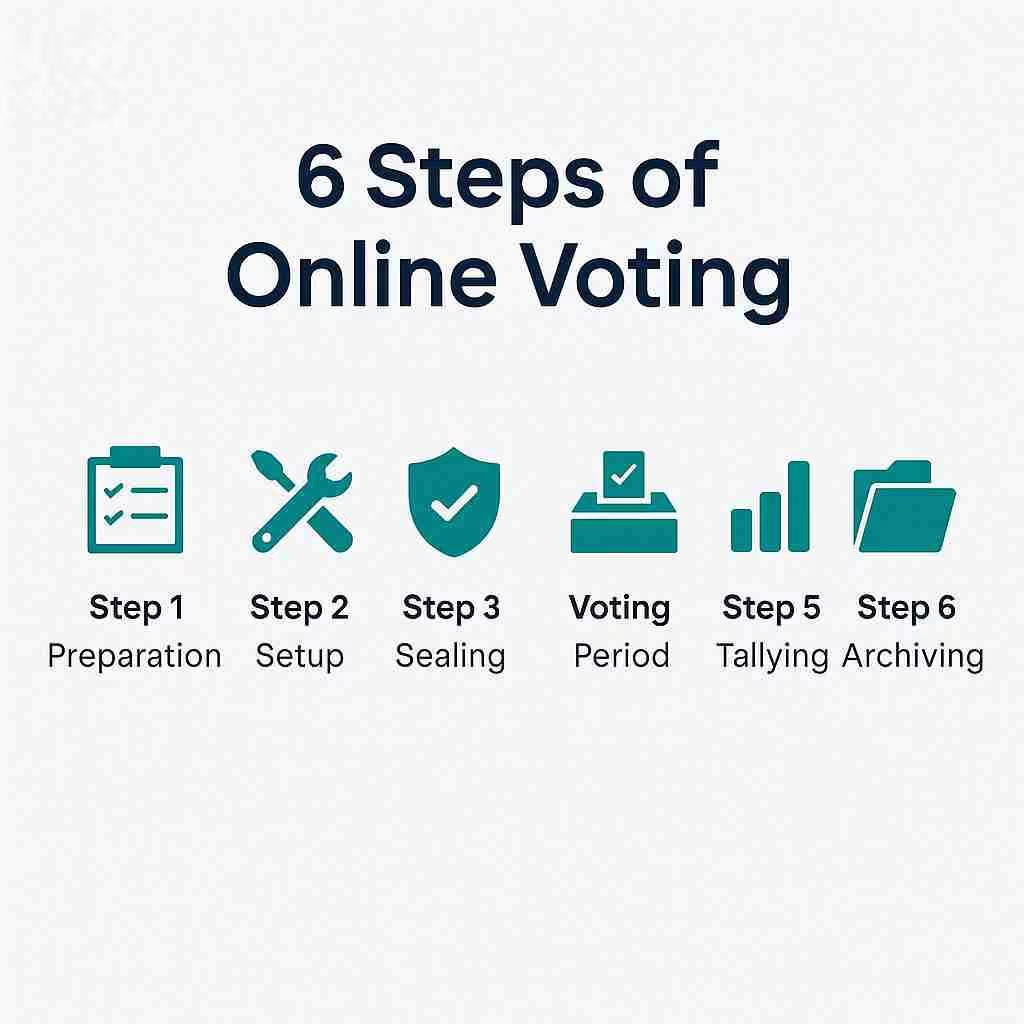
Online voting covers the entire lifecycle:
- invitations / voting materials,
- authentication,
- verification,
- proxies,
- secret ballot,
- tallying,
- final report.
The Digital Ballot Box: One Component of the System
It is the secure vault that stores encrypted ballots.
Online Voting: A Complete Process
Online voting includes every step from the invitation to the final report.
Why This Distinction Matters
It helps organizations evaluate platforms accurately and understand the guarantees required at each stage.
🔗 Further Reading
👉 Also read: How an Online Vote Works from Start to Finish
👉 Explore Voteer Case Studies
👉 Discover the Voteer Online Voting Platform